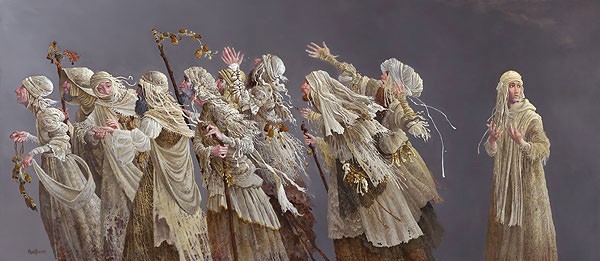
Transfiguration

On the last Sunday before Lent the Church focuses on the story of what we describe as “the transfiguration of Jesus”. Perhaps we do this to be reminded that there is no place for any follower of Jesus to pitch a tent where we stay put, continually thinking about the moments of success and truth which occasionally come our way.
Like the disciples with Jesus on the mountain, we too are privileged to stand within God's salvation history: between being given the Law, the prophets and the life, death and resurrection of Jesus.
Sometimes we see hints of the glory which lies ahead, but, if we were to settle now for 'the seeds of the promise' while we are still on the journey, we would miss out on the promise itself.
We must follow a suffering Jesus along a way of the Cross to come to the glory.

Matthew 17:1-9

1 Six days later, Jesus took with him Peter and James and his brother John and led them up a high mountain, by themselves. 2 And he was transfigured before them, and his face shone like the sun, and his clothes became dazzling white. 3 Suddenly there appeared to them Moses and Elijah, talking with him. 4 Then Peter said to Jesus, “Lord, it is good for us to be here; if you wish, I will make three dwellings here, one for you, one for Moses, and one for Elijah.” 5 While he was still speaking, suddenly a bright cloud overshadowed them, and from the cloud a voice said, “This is my Son, the Beloved; with him I am well pleased; listen to him!” 6 When the disciples heard this, they fell to the ground and were overcome by fear. 7 But Jesus came and touched them, saying, “Get up and do not be afraid.” 8 And when they looked up, they saw no one except Jesus himself alone. 9 As they were coming down the mountain, Jesus ordered them, “Tell no one about the vision until after the Son of Man has been raised from the dead.”


Alstonville Anglicans
Epiphany 6 How Righteousness works in daily life

How righteousness works in daily life
The Pharisees said that righteousness consisted of performing certain actions,……doing things.
However, Jesus wanted people to know that your relationship with God was all about how you were thinking …. Your motivation.

It was the same with sin.  The Pharisees had a list of external actions that were sinful, but Jesus explained that sin (falling short of God’s plan for us) actually begins with having the wrong attitude.

So, in the Gospel today Jesus speaks plainly about the effect of wrong attitudes or wrong thinking.

We are told that anger is murder in the heart. Jesus didn’t say that anger leads to murder; He said that anger IS murder. Anger is an unhelpful thing which makes us destroyers instead of builders. Anger robs us of freedom and makes us prisoners. To hate someone is to commit murder in our hearts.

Similarly, lust is actually adultery and envy is in effect stealing.

Jesus taught that our conversation should be so honest and our character so true that we don’t need to “swear by the hair of your chinny, chin, chin” or “cross my heart and spit” to have people believe us.

Words depend on character and swearing oaths can’t compensate for a poor character.  The more words someone uses to convince us, the more
suspicious we should be.

We honour God by being thoughtful about what we say.

Matthew 17:1–9 (NRSV)

1 Six days later, Jesus took with him Peter and James and his brother John and led them up a high mountain, by themselves. 2 And he was transfigured before them, and his face shone like the sun, and his clothes became dazzling white. 3 Suddenly there appeared to them Moses and Elijah, talking with him. 4 Then Peter said to Jesus, “Lord, it is good for us to be here; if you wish, I will make three dwellings here, one for you, one for Moses, and one for Elijah.” 5 While he was still speaking, suddenly a bright cloud overshadowed them, and from the cloud a voice said, “This is my Son, the Beloved; with him I am well pleased; listen to him!” 6 When the disciples heard this, they fell to the ground and were overcome by fear. 7 But Jesus came and touched them, saying, “Get up and do not be afraid.” 8 And when they looked up, they saw no one except Jesus himself alone. 9 As they were coming down the mountain, Jesus ordered them, “Tell no one about the vision until after the Son of Man has been raised from the dead.”


Alstonville Anglicans
Epiphany 5, Salt and Light

Salt and Light
Jesus doesn’t say, “You will be the salt of the earth” or “You have within you the potential to become the salt of the earth.” He says, “You ARE the salt of the earth”. We are being told that, by God’s grace, the miracle of our transformation has already begun.

Salt has little influence while sitting in a salt shaker. However, it has great value when we mix it, in the right proportions, into our food. When it is sprinkled on (or cooked into) our food, it changes the food into something very tasty and desirable.
Our congregations are sometimes small, but that doesn’t matter. Just as a few grains of salt can make a big difference in food, so also a few faithful Christians can make a big difference in the world.
Jesus also says to his disciples, “You are the light of the world.” Our light comes from our relationship to Christ. Our light is not our own, but is the reflection of Jesus’ light.
Christ intends each of us to be a light. Some will be small lights and some will be bigger, but we are all to shine brightly ….. a thousand points of light …. a million points …. a billion!
If every Christian had her or his light turned on, this would be a very different world!

Matthew 5:13-20
13 “You are the salt of the earth, but if salt has lost its taste, how shall its saltiness be restored? It is no longer good for anything except to be thrown out and trampled under people’s feet. 14 “You are the light of the world. A city set on a hill cannot be hidden. 15 Nor do people light a lamp and put it under a basket, but on a stand, and it gives light to all in the house. 16 In the same way, let your light shine before others, so that they may see your good works and give glory to your Father who is in heaven. 17 “Do not think that I have come to abolish the Law or the Prophets; I have not come to abolish them but to fulfill them. 18 For truly, I say to you, until heaven and earth pass away, not an iota, not a dot, will pass from the Law until all is accomplished. 19 Therefore whoever relaxes one of the least of these commandments and teaches others to do the same will be called least in the kingdom of heaven, but whoever does them and teaches them will be called great in the kingdom of heaven. 20 For I tell you, unless your righteousness exceeds that of the scribes and Pharisees, you will never enter the kingdom of heaven.


Alstonville Anglicans
Epiphany 4

It’s always encouraging to get to the point where we are “half way” there. It’s the point when we become much more likely to continue on than to go back. This weekend, our Rector Desiree is half way through her long service leave.

And this Fourth Sunday after Epiphany is when we are half way between the Season of Christmas and the Season of Lent. A good time to reflect on our journey (that is our Spiritual Journey).

Was the beginning at Christmas really exciting and meaningful? Or was it just another round of the same old stuff we always do with a little bit of Celebrating Baby Jesus thrown in?

Do we see any real significance in the approach of Lent? Some people might be starting to think of Lent coming up wondering if it mightn’t be a good idea to try giving something up again this year. Others might be planning to do some extra reading or study throughout Lent.
Maybe you are like me and have had the thought pass through your mind that “I just don’t know what I should do”.

As I was preparing for the services this weekend, I discovered the answer in the sentence for today from Micah Chapter 6 Verse 8 … “What does the Lord require of you but to do justice, and to love kindness, and to walk humbly with your God?” 

The Gospel according Matthew 5:1–12

1 Seeing the crowds, he went up on the mountain, and when he sat down, his disciples came to him. 2 And he opened his mouth and taught them, saying: 3 “Blessed are the poor in spirit, for theirs is the kingdom of heaven. 4 “Blessed are those who mourn, for they shall be comforted. 5 “Blessed are the meek, for they shall inherit the earth. 6 “Blessed are those who hunger and thirst for righteousness, for they shall be satisfied. 7 “Blessed are the merciful, for they shall receive mercy. 8 “Blessed are the pure in heart, for they shall see God. 9 “Blessed are the peacemakers, for they shall be called sons of God. 10 “Blessed are those who are persecuted for righteousness’ sake, for theirs is the kingdom of heaven. 11 “Blessed are you when others revile you and persecute you and utter all kinds of evil against you falsely on my account. 12 Rejoice and be glad, for your reward is great in heaven, for so they persecuted the prophets who were before you.


Alstonville Anglicans
Christmas 1

Whiplash. That is the only way to describe this week’s Gospel. From the joy of Christ’s birth, we plummet to a genocidal massacre of innocents in a few short verses. Matthew 2.13-23 briefly describes the life of the Holy Family as refugees. Fleeing religious and political persecution, Mary, Joseph, and Jesus escape to Egypt. Back home in Jerusalem, king Herod slaughters all male infants in an attempt to preserve power at all costs. The episode of genocide connects Christ with Israel’s past traditions and his future work. The consequence of Christ’s work is execution. Christ disrupts the status quo and so we live a prayer of lovingkindness for disrupted lives: refugees, survivors of fire and flood, those fleeing persecution of any kind, and those living the joyful disruption of parenthood, new faith and transformed lives.


Alstonville Anglicans
Advent 4

ADVENT LOVE— We are in the fourth week of getting ready to come close to the mystery of Christmas. In this fourth week we remember the Magi, the wise people. They came from the East and they were so wise that people thought they were magic. We get our word magic from the name they were called in their language – Magi. Of all the things they knew, they knew the most about stars. When they noticed a wild star they were curious and decided to follow where it was going. The wild star led the Magi to love – the Christ child. The fourth candle is lit for the charism of love. The Magi do for Jesus the Christ child what he cannot do for himself – they assure him of love.
There are some things that human beings cannot do for themselves, Jesus included. No human can teach him or herself language. Human beings cannot assure themselves of their worth, that they are heard, valued and taken seriously. The gift of love is the real gift that the Magi offer Jesus. The treasures the magi offer Jesus assure him that he is worthy, valued, noticed, heard and taken seriously.

The Gospel according Matthew 1:18–25

18 Now the birth of Jesus Christ took place in this way. When his mother Mary had been betrothed to Joseph, before they came together she was found to be with child from the Holy Spirit. 19 And her husband Joseph, being a just man and unwilling to put her to shame, resolved to divorce her quietly. 20 But as he considered these things, behold, an angel of the Lord appeared to him in a dream, saying, “Joseph, son of David, do not fear to take Mary as your wife, for that which is conceived in her is from the Holy Spirit. 21 She will bear a son, and you shall call his name Jesus, for he will save his people from their sins.” 22 All this took place to fulfill what the Lord had spoken by the prophet: 23 “Behold, the virgin shall conceive and bear a son, and they shall call his name Immanuel” (which means, God with us). 24 When Joseph woke from sleep, he did as the angel of the Lord commanded him: he took his wife, 25 but knew her not until she had given birth to a son. And he called his name Jesus.


Alstonville Anglicans
Advent 2

ADVENT PEACE— Perhaps some images of Advent will guide us into its meaning. Images that are helpful are lessons from nature; how seeds grow in dirt and darkness, hidden from the sun’s light. Another image is of a child growing in its mother’s womb, hidden, mysterious, uncertain, but growing to maturity in darkness.

Similarly Advent is a time of darkness for us; we are set free to embrace doubt and questions. In fact doubt is often a sign of spiritual growth: the more faith the more doubt. In advent we embrace darkness, doubt and questioning. As a child grows in the darkness of the womb, so too does our faith grow in darkness, in doubt, in questioning, in waiting. So much of our faith is about being “full” and so much of our spirituality is about having answers. Some expect their faith to make their life full: full of happiness, full of answers. The Creed for example is too direct, too exact, too correct, too forceful, too right. We expect of ourselves to constantly be on a spiritual high, to always feel the immediate presence of God, to always have peace and joy. In contrast Advent asks us for “emptiness.” Advent asks us to be comfortable with our questions and our doubt and wants us to realise that doubt is the other side of faith. Advent is about owning the shadows, not turning our backs on them and trusting that they will eventually lead us to God, albeit by another road.

The Gospel according Matthew 3:1–12

1 In those days John the Baptist appeared in the wilderness of Judea, proclaiming, 2 “Repent, for the kingdom of heaven has come near.” 3 This is the one of whom the prophet Isaiah spoke when he said, “The voice of one crying out in the wilderness: ‘Prepare the way of the Lord, make his paths straight.’ ” 4 Now John wore clothing of camel’s hair with a leather belt around his waist, and his food was locusts and wild honey. 5 Then the people of Jerusalem and all Judea were going out to him, and all the region along the Jordan, 6 and they were baptized by him in the river Jordan, confessing their sins. 7 But when he saw many Pharisees and Sadducees coming for baptism, he said to them, “You brood of vipers! Who warned you to flee from the wrath to come? 8 Bear fruit worthy of repentance. 9 Do not presume to say to yourselves, ‘We have Abraham as our ancestor’; for I tell you, God is able from these stones to raise up children to Abraham. 10 Even now the ax is lying at the root of the trees; every tree therefore that does not bear good fruit is cut down and thrown into the fire. 11 “I baptize you with water for repentance, but one who is more powerful than I is coming after me; I am not worthy to carry his sandals. He will baptize you with the Holy Spirit and fire. 12 His winnowing fork is in his hand, and he will clear his threshing floor and will gather his wheat into the granary; but the chaff he will burn with unquenchable fire.”

The Gospel according Matthew 3:1–12

1 In those days John the Baptist appeared in the wilderness of Judea, proclaiming, 2 “Repent, for the kingdom of heaven has come near.” 3 This is the one of whom the prophet Isaiah spoke when he said, “The voice of one crying out in the wilderness: ‘Prepare the way of the Lord, make his paths straight.’ ” 4 Now John wore clothing of camel’s hair with a leather belt around his waist, and his food was locusts and wild honey. 5 Then the people of Jerusalem and all Judea were going out to him, and all the region along the Jordan, 6 and they were baptized by him in the river Jordan, confessing their sins. 7 But when he saw many Pharisees and Sadducees coming for baptism, he said to them, “You brood of vipers! Who warned you to flee from the wrath to come? 8 Bear fruit worthy of repentance. 9 Do not presume to say to yourselves, ‘We have Abraham as our ancestor’; for I tell you, God is able from these stones to raise up children to Abraham. 10 Even now the ax is lying at the root of the trees; every tree therefore that does not bear good fruit is cut down and thrown into the fire. 11 “I baptize you with water for repentance, but one who is more powerful than I is coming after me; I am not worthy to carry his sandals. He will baptize you with the Holy Spirit and fire. 12 His winnowing fork is in his hand, and he will clear his threshing floor and will gather his wheat into the granary; but the chaff he will burn with unquenchable fire.”

Alstonville Anglicans
Advent 3

ADVENT JOY— The third candle is pink and symbolizes joy. It is called the “Shepherd’s Candle,” and is pink because rose is a liturgical colour for joy. The third Sunday of Advent is Gaudete Sunday and is meant to remind us of the joy that the world experienced at the birth of Jesus, as well as the joy that the faithful have reached the midpoint of Advent.

Rolheiser (2002) writes that: Every year on the third Sunday of Advent, the church asks us to do a meditation on joy. That seems a curious thing to ask, though it becomes less curious when we actually reflect on the nature of joy. What is joy?

Few things are as misunderstood as is the notion of joy. Of itself that wouldn’t be serious except that in this case we are often left chasing the wrong things in life.

Too often we confuse joy with good cheer or with a certain rallying of the spirit that we try to crank up when we go to a party or let off steam on a Friday night. We tend to think of joy this way: There is ordinary time in our lives, when duty, work, emotional and financial burdens, tiredness, worries, and pressure of all kinds keep us from enjoying life and from being as cheery and pleasant as we would like. We think of ordinary times in our lives as keeping us from joy – the grind, the routine, the rat-race, the work-week – and so we look forward to special times, weekends, nights out, vacation times, social times, celebrations, and parties where we can break the routine, break out, enjoy ourselves, and experience joy.

Joy then is identified with the boisterous good cheer we try to crank up at parties or the lack of pressure and the freedom from burdens that we feel when on vacation. But is this joy? It can be, though often isn’t. The loud robust cheer that we enter into at parties is often little more than a desperate effort to keep our depressions at bay, a form of denial. That’s why the good cheer dissolves so quickly when we go home and why, three days after returning from vacation, we are again just as tired and in need of a vacation as before.

What is joy? Joy can never be induced, cranked up, or made to happen. It’s something that has to find us precisely within our ordinary, duty-bound, burdened, full-of-worries, and pressured lives…. You can’t find joy, it has to find you. That’s its real quality. As the various versions of The Prayer of St. Francis put it, we can never attain joy, consolation, peace, forgiveness, love, and understanding by actively pursuing them. We attain them by giving them out…The great mystic, John of the Cross, ends one of his most famous instructions with this poem:

To reach satisfaction in all
desire its possession in nothing.
To come to possess all
desire the possession of nothing.
To arrive at being all
desire to be nothing.
To come to the knowledge of all
desire the knowledge of nothing.
To come to the pleasure you have not
you must go by the way in which you enjoy not.
To come to the knowledge you have not
you must go by a way in which you know not.
To come to the possession you have not
you must go by a way in which you possess not.
To come to be what you are not
you must go by a way in which you are not.
That, and that alone, is a recipe for joy.

Alstonville Anglicans
Zacchaeus

“Zacchaeus” means pure and righteous one. He is a tax collector. He is the chief tax collector. In other words, he is a thug. Tax collectors were grouped with murderers. They killed people in other ways; they killed them by depriving them of that which is needed to sustain life.

 Jesus calls this tax collector, this thug, pure and righteous one. Jesus refuses to see us in the shadow of our past. He chooses to see us in the light of our future. When Jesus greets any one of us, he calls us Zacchaeus. You pure and righteous one. It is a greeting of grace.

 Grace touches this little person’s life.  Zacchaeus is a little man. A little man; little in all the things that matter: Little in gentleness. Little in generosity. Little in love. This tax collector spent his whole life hoarding. Now he spends his life sharing. Up to 50 percent. Which is forty percent more than ten percent. May God have mercy on the church who has limited our generosity to ten percent. When grace touches little lives, that life is filled with gratitude. And gratitude overflows in generosity. Andrew Harvey writes that “it is
essential to learn how to awaken and sustain gratitude, for gratitude is the key to many of the highest, most noble, and most transformatory sacred emotions. A heart tuned constantly to be grateful comes to revere the Divine in the whole of existence and slowly to recognize the unity of the Presence behind all diverse appearances. A heart trained always to be grateful will also grow more and more humble; it will be fearless in its recognition of how everything it loves, needs, and celebrates streams in a never-ending river of grace from God.” May our All Saints experience be characterised by gratitude. (in The Direct Path: Creating a Journey to the Divine Using the World's Mystical Traditions).

The Gospel according to Luke 6:20–36

20 Then he looked up at his disciples and said: “Blessed are you who are poor, for yours is the kingdom of God. 21 “Blessed are you who are hungry now, for you will be filled. “Blessed are you who weep now, for you will laugh. 22 “Blessed are you when people hate you, and when they exclude you, revile you, and defame you on account of the Son of Man. 23 Rejoice in that day and leap for joy, for surely your reward is great in heaven; for that is what their ancestors did to the prophets. 24 “But woe to you who are rich, for you have received your consolation. 25 “Woe to you who are full now, for you will be hungry. “Woe to you who are laughing now, for you will mourn and weep. 26 “Woe to you when all speak well of you, for that is what their ancestors did to the false prophets. 27 “But I say to you that listen, Love your enemies, do good to those who hate you, 28 bless those who curse you, pray for those who abuse you. 29 If anyone strikes you on the cheek, offer the other also; and from anyone who takes away your coat do not withhold even your shirt. 30 Give to everyone who begs from you; and if anyone takes away your goods, do not ask for them again. 31 Do to others as you would have them do to you. 32 “If you love those who love you, what credit is that to you? For even sinners love those who love them. 33 If you do good to those who do good to you, what credit is that to you? For even sinners do the same. 34 If you lend to those from whom you hope to receive, what credit is that to you? Even sinners lend to sinners, to receive as much again. 35 But love your enemies, do good, and lend, expecting nothing in return. Your reward will be great, and you will be children of the Most High; for he is kind to the ungrateful and the wicked. 36 Be merciful, just as your Father is merciful.”


Alstonville Anglicans
The Eye of the Needle

Luke 18:25 is awkward to hear: “how hard it is for the rich to enter the kingdom of God. It is easier for a camel to go through an eye of a needle than for the rich to enter the kingdom of heaven.” Ched Meyers (2001:32) says that: “The clarity of the text has somehow escaped the church through the ages, which instead has concocted a hundred ingenious reasons why it cannot mean what it says”. The church has been so anxious that Jesus may be saying something negative about the rich but it is not about us at all! The text (Lk 18:15-30) is not about the rich, it is about the kingdom of God!

 For Jesus, the kingdom of God is a social condition where there are no rich or poor. Thus Jesus challenges the ruler with economic justice as a precondition for discipleship: “there is one thing lacking, sell all you have, give it to the poor and you will have treasures in heaven, and then follow me” (Lk 18:22). Jesus has re- interpreted currency/wealth for him.

 The context of the conversation between Jesus and the ruler may be helpful. In first century Palestine, land was the basis of wealth. The primary means for acquiring wealth/land for the rich ruler (Lk 18:18) was the debt-default of the poor. Small landowners/households were oppressed because of an immense burden of tax, rent, tariffs and tithes. Loans secured with their land were necessary to pay these expenses. Loans were obtained from wealthy landowners. Land belonging to small households was lost to these lenders when payments fell behind. The rich lenders became even richer through gaining land from the poor who became poorer. This is how the rich were too rich and the poor were too poor. This is the background of how one would be a “ruler” and “rich” in the context of the first three Gospels.

 The implication of Lk 18:22 is that Jesus expects the ruler to deconstruct the economic and political system from which he derives his privilege.  Why? Because the kingdom of God is a place where there are no rich and poor. Stung, the ruler walks away. Disbelieving, the disciples anticipate our question: “who then can be saved?”  With God all things are possible, says Jesus.

 Is the kingdom of God as Jesus envisions it a possibility? Is it possible that some can deconstruct economic and political systems from which they gain privilege/wealth as a precondition for the kingdom of God?

 The Gospel according to Luke 18:15–30

15 People were bringing even infants to him that he might touch them; and when the disciples saw it, they sternly ordered them not to do it. 16 But Jesus called for them and said, “Let the little children come to me, and do not stop them; for it is to such as these that the kingdom of God belongs. 17 Truly I tell you, whoever does not receive the kingdom of God as a little child will never enter it.” 18 A certain ruler asked him, “Good Teacher, what must I do to inherit eternal life?” 19 Jesus said to him, “Why do you call me good? No one is good but God alone. 20 You know the commandments: ‘You shall not commit adultery; You shall not murder; You shall not steal; You shall not bear false witness; Honor your father and mother.’ ” 21 He replied, “I have kept all these since my youth.” 22 When Jesus heard this, he said to him, “There is still one thing lacking. Sell all that you own and distribute the money to the poor, and you will have treasure in heaven; then come, follow me.” 23 But when he heard this, he became sad; for he was very rich. 24 Jesus looked at him and said, “How hard it is for those who have wealth to enter the kingdom of God! 25 Indeed, it is easier for a camel to go through the eye of a needle than for someone who is rich to enter the kingdom of God.” 26 Those who heard it said, “Then who can be saved?” 27 He replied, “What is impossible for mortals is possible for God.” 28 Then Peter said, “Look, we have left our homes and followed you.” 29 And he said to them, “Truly I tell you, there is no one who has left house or wife or brothers or parents or children, for the sake of the kingdom of God, 30 who will not get back very much more in this age, and in the age to come eternal life.”


Alstonville Anglicans
The Widow

It may come as no surprise to you that I wholeheartedly reject the bog-standard interpretation of this parable dished up by unimaginative and lazy interpretations of scripture. Does this parable mean that if we want something from God we should just pray? If it doesn’t arrive, pray harder. Still nothing? Keep trying…pray harder still. If you pray hard enough God will eventually give you what you want, even if it’s to stop you nagging. Such an interpretation relies on God being a disinterested authority figure who has little interest in humanity but is willing to be manipulated by enough nagging.

The radical thing about Jesus’ story of the persistent widow beseeching a judge for fairness can only be grasped from the perspective of first century Judaism.  In Hebrew the word for widow is often almanah which translates as a person with little influence, one who is silent. In addition to her vulnerability as an unprotected, unmarried woman living at the margins of society with little access to resources, she is expected to ‘be seen and not heard’, to quote an antiquated approach to parenting. Here we have a radical, empowered woman with agency to name her needs and claim the power of naming. Naming is central to identity. A person is identified through names, to be a person is to have a name. Sometimes names can be ascribed and forced on others against their will.

Who are the vulnerable and the silent that we need to be listening to?

 The Gospel according to Luke 18:1–8

1 Then Jesus told them a parable about their need to pray always and not to lose heart. 2 He said, “In a certain city there was a judge who neither feared God nor had respect for people. 3 In that city there was a widow who kept coming to him and saying, ‘Grant me justice against my opponent.’ 4 For a while he refused; but later he said to himself, ‘Though I have no fear of God and no respect for anyone, 5 yet because this widow keeps bothering me, I will grant her justice, so that she may not wear me out by continually coming.’ ”6 And the Lord said, “Listen to what the unjust judge says. 7 And will not God grant justice to his chosen ones who cry to him day and night? Will he delay long in helping them? 8 I tell you, he will quickly grant justice to them. And yet, when the Son of Man comes, will he find faith on earth?”


Alstonville Anglicans
Gratitude Pentecost 18

The story of the ten lepers is an obvious lesson in gratitude:  “and one of them, realizing he had been healed, returned, glorifying God in a loud voice; and he fell at the feet of Jesus and thanked him.”  That leper was “made well,” (from the Greek sesoken). The other nine were cleansed (ekatharisthesan). Gratitude is an indelible part of fully human integrated wholeness that is far deeper than merely being cured. Best understood, holiness is the person at home with herself, relaxed in a joyful wholeness that knits together all healed wounds into a connection with life, others and Great Creator Spirit. The mark of this holiness is gratitude.  Ronald Rolheiser writes: “Gratitude is the basis for all holiness.  The holiest person you know is also the most grateful person you know.”  (Sacred Fire 2014 (New York: Penguin).  Meister Eckhart said that if the only prayer you have ever prayed is ‘Thank You’, you have prayed enough.

 The Gospel according to Luke 17:11–19

11 On the way to Jerusalem Jesus was going through the region between Samaria and Galilee. 12 As he entered a village, ten lepers approached him. Keeping their distance, 13 they called out, saying, “Jesus, Master, have mercy on us!” 14 When he saw them, he said to them, “Go and show yourselves to the priests.” And as they went, they were made clean. 15 Then one of them, when he saw that he was healed, turned back, praising God with a loud voice. 16 He prostrated himself at Jesus’ feet and thanked him. And he was a Samaritan. 17 Then Jesus asked, “Were not ten made clean? But the other nine, where are they? 18 Was none of them found to return and give praise to God except this foreigner?” 19 Then he said to him, “Get up and go on your way; your faith has made you well.”


Alstonville Anglicans
Forgiveness Pentecost 17

One of the hardest things to do is to forgive. In Luke 17:4, using a metaphor of a mulberry tree, Jesus describes the hard work of forgiving. Forgiving repeatedly is to forgive comprehensively: rooting out bitterness and giving up the tendency to rehearse one’s pain. A mulberry tree has a vast network of roots radiating out in all directions. It is an enormous task to pull out all the roots without leaving a trace of one left.  How do we achieve the heart wrenching task of a lifestyle of forgiveness? The Good News is that the tiniest seed of faith will guarantee success. Faith is a gift so powerful that it could stroke the ego. Thus, using the image of a slave’s call to serve continuously, Jesus warns about being humble and grounded and not taking faith for granted; . The vocation to authentic humility is unwelcome and prepares us for the ingratitude of the nine lepers in the next episode.

 The Gospel according to Luke 17:5–10

5 The apostles said to the Lord, “Increase our faith!” 6 The Lord replied, “If you had faith the size of a mustard seed, you could say to this mulberry tree, ‘Be uprooted and planted in the sea,’ and it would obey you. 7 “Who among you would say to your slave who has just come in from plowing or tending sheep in the field, ‘Come here at once and take your place at the table’? 8 Would you not rather say to him, ‘Prepare supper for me, put on your apron and serve me while I eat and drink; later you may eat and drink’? 9 Do you thank the slave for doing what was commanded? 10 So you also, when you have done all that you were ordered to do, say, ‘We are worthless slaves; we have done only what we ought to have done!’ ”


Alstonville Anglicans
St Francis of Assisi

Saint Francis of Assisi who was born in 1181, grew up in a life of luxury and abandoned it for a life devoted to Christianity.  He reportedly heard the voice of God, who commanded him to rebuild the Christian church and live in poverty. He is the patron saint of animals and the environment. St Francis is an excellent role model for a Christian journey to the Father, Son and Holy Spirit.  He is known for setting up the men's Order of Friars Minor, the women's Order of Saint Clare, the Third Order of Saint Francis  and for his work helping the poor and befriending outcasts like the lepers. The three orders today are worldwide and clergy and lay people are welcome to join the Third Order and continue to follow their ordinary professions of life. In a sense, every Christian needs to be a risk-taker for Christ in this generation. Those who stick to the old familiar traditional ways may just about keep us afloat.
Only those who embrace new ways and explore fresh places will reverse decline and bring renewed life. It must be in the spirit of Francis to be part of that creativity.

Matthew 6:25-29

25 “Therefore I tell you, do not worry about your life, what you will eat or what you will drink, or about your body, what you will wear. Is not life more than food, and the body more than clothing? 26 Look at the birds of the air; they neither sow nor reap nor gather into barns, and yet your heavenly Father feeds them. Are you not of more value than they? 27 And can any of you by worrying add a single hour to your span of life?28 And why do you worry about clothing? Consider the lilies of the field, how they grow; they neither toil nor spin, 29 yet I tell you, even Solomon in all his glory was not clothed like one of these.


Alstonville Anglicans
Cosmos

The fourth Sunday in the Season of Creation is Cosmos Sunday. The Cosmos refers to the entire universe,
every dimension of time and space, spiritual and material. The cosmos is both the glittering galaxies that humans have begun to explore as well as distant domains far beyond our imagination.  In addition, there are unknown domains deep within each minute molecule we have yet to comprehend. All creation is one sacred cosmos, a spiritual universe filled with God’s presence.

Perhaps we are ready to consider how the Season of Creation has changed us. How Can We Take it Further?  

Calculate your carbon footprint! Give everyone a card with the address of the carbon footprint calculator:  http://www.carbonneutral.com.au/carbon-calculator.html. Ask them to spend the week completing the calculations and reflecting on the effect of their carbon footprint on the earth. 

Consider Ethical investment. 

Superswitch ranks superannuation funds by how much of their investment is free from fossil fuels. See how your super is invested and maybe switch to a better fund. You can also ask your current fund to invest more ethically. http://superswitch.org.au/

 Market Forces lists the banks. See if your bank invests in fossil fuels. Consider switching to a bank that doesn’t. 

Choice Magazine has an ethical investing guide which explains some terms and concepts. 

Go Fossil Free Australia has step by step guides for taking your money out of fossil fuels. https://gofossilfree.org.au

John 6:41-51

41 Then the Jews began to complain about him because he said, “I am the bread that came down from heaven.” 42 They were saying, “Is not this Jesus, the son of Joseph, whose father and mother we know? How can he now say, ‘I have come down from heaven’?” 43 Jesus answered them, “Do not complain among yourselves. 44 No one can come to me unless drawn by the Father who sent me; and I will raise that person up on the last day. 45 It is written in the prophets, ‘And they shall all be taught by God.’ Everyone who has heard and learned from the Father comes to me. 46 Not that anyone has seen the Father except the one who is from God; he has seen the Father. 47 Very truly, I tell you, whoever believes has eternal life. 48 I am the bread of life. 49 Your ancestors ate the manna in the wilderness, and they died. 50 This is the bread that comes down from heaven, so that one may eat of it and not die. 51 I am the living bread that came down from heaven. Whoever eats of this bread will live forever; and the bread that I will give for the life of the world is my flesh.”


Alstonville Anglicans
Storm

Human activity significantly affects the amount of water and the quality of water available to other humans and non-human species as well. The Bible tells us that in the beginning God brought forth the earth itself from the waters. Accordingly, in the Bible, water represents the essence of life, without which there could be no life. We are called to appreciate water as a life-giving gift from God, to be used for God’s creative and life-giving purposes.

This Sunday Storm refers to the world of the weather, the gales, the lighting, the winds, the cyclones, the hurricanes, the downpours and the flash floods outback..  Storm means both nature in the raw and the weather we need to renew our planet.  Storms may be events that frighten us, but they are also events that we celebrate in the weather cycle that sustains Earth as a living planet.

Luke 8:22-25

22 One day he got into a boat with his disciples, and he said to them, “Let us go across to the other side of the lake.” So they put out, 23 and while they were sailing he fell asleep. A windstorm swept down on the lake, and the boat was filling with water, and they were in danger. 24 They went to him and woke him up, shouting, “Master, Master, we are perishing!” And he woke up and rebuked the wind and the raging waves; they ceased, and there was a calm. 25 He said to them, “Where is your faith?” They were afraid and amazed, and said to one another, “Who then is this, that he commands even the winds and the water, and they obey him?”


Alstonville Anglicans
Fauna

The scriptures begin with God’s affirmation that all of creation is “very good,” and as the stewards of God’s creation, we are called to protect its goodness. (Genesis 1:30, Genesis 1:28, Jeremiah 29:5-7) Every species, indeed every being of every species, is precious because it is made by God. All reflect an aspect of God. “How many are your works, Lord! In wisdom you made them all; the earth is full of your creatures.”
(Psalm 104:24) 

 We lament that God’s creatures are disappearing from the Earth at a rate we can scarcely comprehend. From humble insects to majestic mammals, from microscopic plankton to towering trees, creatures from across God’s dominion are becoming extinct, and may never be seen again. 

The second Sunday in the season of creation acknowledges Fauna. Fauna refers to the all the living species on planet Earth—in the wild, in our lives and in our soils.  In Genesis One, all living species emerge from Earth who is their common mother.  In Genesis Two, the first human and all animals are created from clay and the breath of God.  In Job 39, the kingdom of the wild is God’s special concern, no matter how remote or mysterious. 

 Luke 12:22-31

22 He said to his disciples, “Therefore I tell you, do not worry about your life, what you will eat, or about your body, what you will wear. 23 For life is more than food, and the body more than clothing. 24 Consider the ravens: they neither sow nor reap, they have neither storehouse nor barn, and yet God feeds them. Of how much more value are you than the birds! 25 And can any of you by worrying add a single hour to your span of life?26 If then you are not able to do so small a thing as that, why do you worry about the rest? 27 Consider the lilies, how they grow: they neither toil nor spin; yet I tell you, even Solomon in all his glory was not clothed like one of these. 28 But if God so clothes the grass of the field, which is alive today and tomorrow is thrown into the oven, how much more will he clothe you—you of little faith! 29 And do not keep striving for what you are to eat and what you are to drink, and do not keep worrying. 30 For it is the nations of the world that strive after all these things, and your Father knows that you need them. 31 Instead, strive for his kingdom, and these things will be given to you as well.


Alstonville Anglicans
Oceans


Every September churches around the world pray for creation in what is now known as the Season of Creation. The Season of Creation is urgent in ways that it has never been before. The UN Climate Chief has warned that we have 12 years left to avoid catastrophic climate damage that will impossible or extremely difficult to reverse. The focus in the first week of the season of creation is the ocean with a focus on the damage that we do:

We celebrate and love the ocean, so why is the ocean a victim of our pollution and damage? What are the reasons for our disregard for the warnings about climate damage?

I suggest that the problem is a spiritual one. Humankind places itself at the centre of creation, separate from it. In truth we are part of creation, one link joined with aspects of creation in a circle of unity. The conversation that is required is a reframing of identity, the idea that we are at the centre must die. Instead we identify ourselves as a part of creation.

An image that may illustrate the point being made is the song-game nursery school children sing and play: here we go around the mulberry bush. The simple game involves holding hands with other children and moving in a circle around a (pretend) mulberry bush. For too long humans have considered that they are the mulberry bush that creation is to go around. We must awaken to the fact that we are to join hands with other dimensions of our cosmos, the fauna and flora, galaxies and microbes, and be a part of the circle.

In poetic language this is the point being made in Ephesians 1v10: “as a plan for the fullness of time, to gather up all things in him, things in heaven and things on earth.”

God’s plan is to unite all things in heaven and on earth into Christ our head (Ephesians 1:10). Christ is all, in all, uniting all. God with us, God in us, God for us, uniting us to each other, uniting us to the earth and uniting us to God. What this means is that absolutely everything finds itself in God. God is all, in all, uniting all. Nothing is excluded. Everything belongs. It is the undoing of separation. Nothing is alienated. That is God’s plan for salvation. The verse is a celebration, a song of unity, every part of creation participates in the love life of God, and it is a cosmic fellowship. In sum: God’s plan is this: salvation means this: everything belongs. The presence of God is in all things uniting all things together.

Here are two stories that deeply evoke our unity with the ocean.

A salt doll journeyed for thousand of miles and stopped at the edge of the sea. It was fascinated by this moving liquid mass, so unlike anything it had seen before. "What are you" asked the salt doll. "Come in and see" replied the sea with a smile. So the salt doll waded in. The further it went, the more it dissolved till there was only a pinch of it left. Before the last bit dissolved the doll exclaimed in wonder, "Now I know what I am ". [1]

salt doll 2.jpg

 A man was walking on the beach one day, carrying his shoes in his hand. He sat down beside a tidal pool and looked at the shells and seaweed left in it. Then he noticed, just above the water line, what looked like a pile of salt. But the salt seemed to have the form of a woman. Then she opened her eyes, smiled, and sat up.

"Are you our salt doll who disappeared into the ocean?" he asked. "But she dissolved in the sea. Are you really the ocean itself?"

"I am both," said the salt doll. "I always was."

"How could you have come back from the sea?" the man asked.

"My purpose brought me back," she said. "I came back to tell you about the ocean. And to tell all you people something you don't seem to know about yourselves. I am no different from you. You are all salt dolls."

The man looked down at his bare foot, and for a moment it looked like it was made of salt.


[1]               From Anthony de Mello (1985:98) in  The Song of the Bird (Doubleday Image)

Alstonville Anglicans
St Bartholomew Pentecost 11

Wounded hero: St Bartholomew and the virtue of vulnerability

Bartholomew was One of the twelve apostles mentioned sixth in the Gospels Matthew, Mark, Luke, and Acts. Bartholomew is not mentioned in John’s Gospel although Nathaniel is. Many people therefore identify Nathaniel with Bartholomew.

Bartholomew is not mentioned in church literature before 260CE Pentanes, Head of the Catechetical School of Alexandria preached in India. Pantaenus was told that Bartholomew had ministered in India and had gifted his converts with the Gospel of Matthew in Hebrew.

It is not exactly known how Bartholomew died. Some sources say that he was beheaded. Other sources indicate that Bartholomew was skinned alive. In art, Bartholomew is often depicted holding his flayed skin; an image that evokes deep vulnerability. Vulnerability is not often considered a virtue, yet vulnerability is the core of being human. How do we come to terms with our vulnerability? As a wounded hero, Bartholomew is an icon for us in exploring the virtues of vulnerability for individuals, community and society. Where are the safe places that you can remove your skin and be vulnerable with another? When and where is vulnerability inherent for you? In what ways can your vulnerability be a virtue?

 Luke 13:10-17

10 Now he was teaching in one of the synagogues on the sabbath. 11 And just then there appeared a woman with a spirit that had crippled her for eighteen years. She was bent over and was quite unable to stand up straight. 12 When Jesus saw her, he called her over and said, “Woman, you are set free from your ailment.” 13 When he laid his hands on her, immediately she stood up straight and began praising God. 14 But the leader of the synagogue, indignant because Jesus had cured on the sabbath, kept saying to the crowd, “There are six days on which work ought to be done; come on those days and be cured, and not on the sabbath day.” 15 But the Lord answered him and said, “You hypocrites! Does not each of you on the sabbath untie his ox or his donkey from the manger, and lead it away to give it water? 16 And ought not this woman, a daughter of Abraham whom Satan bound for eighteen long years, be set free from this bondage on the sabbath day?” 17 When he said this, all his opponents were put to shame; and the entire crowd was rejoicing at all the wonderful things that he was doing.


Alstonville Anglicans
Vineyards Pentecost 10

Sinéad O'Connor writes the following song where Jerusalem refers to Israel and Judah refers to Palestine. It is a moving prayer based on our readings for this week; Isaiah 5:1-7 describing the promising vineyard that gives only wild grapes and God's frustration. Psalm 80 parallels Isaiah but asks for God’s intervention: “Restore us, O Lord of hosts. Let your face shine, that we may be saved”.

If you had a vineyard
On a fruitful hill
And you fenced it and cleared it
Of all stones yountil
You planted it
With the choicest of vine
And you even built a tower
And a press to make wine
And you looked that it would bring forth sweet grapes
And it gave only wild grapes
What would you say
Jerusalem and Judah
You be the judges I pray
Between me and my vineyard
This is what God says

 What more could I have done in it
That I did not do in it
Why when I ask it for sweetness
It brings only bitterness

 For the vineyard of the lord of hosts
Is the house of Israel
And the men of Judah
His pleasant plant

 And he looks for justice but beholds oppression
And he hopes for equality but hears a cry
Jerusalem and Judah
This is god's reply

 Sadness will come
To those who build house to house
And lay field to field 'til there's room
For none but you to dwell in the land
Oh in the land

 And sadness will come
To those who call evil good
And good evil who present
Darkness as light
And light as darkness
Who present as sweetness
Only the things which are
bitterness
For the vineyard of the lord of hosts
Is the house of Israel
And the men of Judah his pleasant plant
Oh oh his pleasant plant

 Oh that my eyes were a fountain of tears
That I might weep for my poor people

 For every boot stamped with fierceness
For every cloak rolled in blood
Jerusalem and Judah
I'd cry if I could
Songwriters: Sinead Marie Bernarde O'connor
If You Had a Vineyard lyrics © O/B/O Apra Amcos

 Luke 12:49-59

49 “I came to bring fire to the earth, and how I wish it were already kindled! 50 I have a baptism with which to be baptized, and what stress I am under until it is completed! 51 Do you think that I have come to bring peace to the earth? No, I tell you, but rather division! 52 From now on five in one household will be divided, three against two and two against three; 53 they will be divided: father against son and son against father, mother against daughter and daughter against mother, mother-in-law against her daughter-in-law and daughter-in-law against mother-in-law.” 54 He also said to the crowds, “When you see a cloud rising in the west, you immediately say, ‘It is going to rain’; and so it happens. 55 And when you see the south wind blowing, you say, ‘There will be scorching heat’; and it happens. 56 You hypocrites! You know how to interpret the appearance of earth and sky, but why do you not know how to interpret the present time? 57 “And why do you not judge for yourselves what is right? 58 Thus, when you go with your accuser before a magistrate, on the way make an effort to settle the case, or you may be dragged before the judge, and the judge hand you over to the officer, and the officer throw you in prison. 59 I tell you, you will never get out until you have paid the very last penny.”


Alstonville Anglicans