
Sermon Notes for Sunday 23rd November on Luke 23:33-43 by Doug Bannerman
Christ the King
In 2020 Hannah Clarke and her three children died a violent death at the hands of her estranged husband. The coroner presiding at the inquest into their deaths found that it was unlikely anything more could have been done to prevent Rowan Baxter from killing his family. However, later evidence provided by whistle blowers from both the police system and the coronial system has cast doubt on that finding.
The Brisbane mother had made repeated disclosures of nonlethal strangulation, stalking, phone hacking, rape and suspected child abuse. She believed that Baxter was capable of killing her, himself and the children. None of these disclosures were logged in the police systems at the time and the coronial system failed to take proper note of the evidence presented.
When Baxter abducted his youngest daughter, he was very charming and persuasive with the two officers who went to his property. Astonishingly, the officers ended up giving him advice on how to thwart the restraining order Hannah Clarke had in place.
Baxter controlled, abused, stalked and killed his estranged wife and their children, having spent days planning the act. A hideous and extreme example of Gender Based Violence (GBV).
The failures of the police and coronial systems beggars belief and, in my opinion, those failures belie the influence of a flawed cultural script in both institutions. I believe that the same flawed script is a feature of Australian culture. A dominant facet of that script is a failure to listen to the woman. It takes extreme courage for a woman to say out loud what is happening behind closed doors.
Shockingly, in 2023 – 2024, one woman was killed by an intimate partner every 8 days on average.
A report in last Friday’s Guardian (21 November 2025) notes that “statistically, the most reliable way to predict a domestic violence homicide is to believe the victim”. LISTEN TO THE WOMAN.
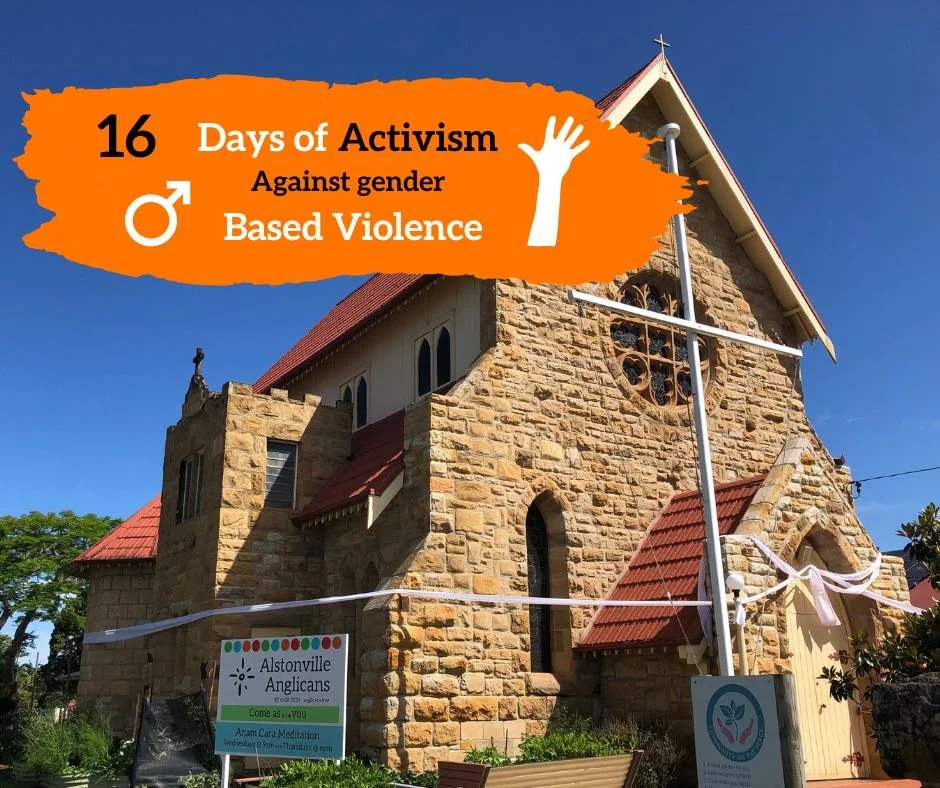
Today is the start of a national 16 days of action against GBV. But we need to take a closer look at what it entails. At first sight we think of physical or sexual violence only; but GBV encompasses far more than that.
Although actual or threatened physical and sexual assaults are common forms of GBV, regular use of other abusive behaviours, when reinforced by one or more acts of physical violence, make up a broader system of abuse known as Coercive Control. Physical assaults may occur only once or very occasionally, but they instil threats of future attacks and allow the abuser to take control of the woman’s life and circumstances.
Here are the characteristics of coercive control.
Intimidation
Employs looks, actions and gestures that make her afraid. Smashes her things. Destroys her property. Abuses pets. Displays weapons.
Emotional Abuse
Puts her down. Makes her feel bad about herself. Calls her names. Makes her think she’s crazy. Plays mind games. Humiliates her. Makes her feel guilty.
Isolation
Controls what she does, who she sees and talks to, where she goes. Limits her outside involvement. Uses jealousy to justify actions.
Minimising, Denying and Blaming
Makes light of the abuse and does not take her concerns seriously. Says the abuse didn’t happen. Shifts responsibility for abusive behaviour. Says she caused it.
Using Children
Makes her feel guilty about the children. Uses the children to relay messages. Uses visitation to harass her. Threatens to take the children away
Economic Abuse
Prevents her from getting or keeping a job. Makes her ask for money. Takes her money. Does not her know about or have access to family income.
Male Privilege
Treats her like a servant. Makes all the big decisions. Acts like the “master of the castle”. Defines the roles of men and women in the relationship.
Coercion and Threats
Makes and/or carries out threats to do something that will hurt her. Threatens suicide. Threatens to report her to welfare. Makes her drop charges. Makes her do illegal things
That’s a brief outline of the dynamics.
In the population at large, something like 25% women experience GBV; but according to a report commissioned by the Anglican Church of Australia, 44% of churchgoing women experience GBV, often exacerbated by the perpetrator’s use of biblical references to justify his opinions and actions. The worst offenders were priests.
Why, then are we discussing this on the last Sunday of the church calendar, when we celebrate Christ the King?
Jesus never, ever, identified himself as a king, although he did say in his conversation with Pilate, “My kingdom is not of this world. If it were, my servants would fight to prevent my arrest by the Jewish leaders. But now my kingdom is from another place.” (John 18.36)
Earthly kings and emperors in Jesus’ time were Roman imperialists predominantly interested in money and power. Their subjects were subjugated, poor, dispossessed, and powerless to determine their own lives. In essence they were survivors of institutional violence.
But you may recall that, in the long history of ancient near East, the relationships between ruler and subject were represented as that between a good shepherd and his sheep. For example, the 6th king of the first dynasty of Babylon, King Hamurabi (1792-1750 BCE), described himself as “shepherd of men” and “supplier of pasture and water”, who has been appointed “to destroy the ruthless and the wicked and to prevent the weak from being robbed of his just rights by the strong.”
So, the ideal of kingship in 1750 BCE included the protection that the true shepherd gives to his flock, by leading the needy to pasture, providing food and drink, and establishing pasturages and places of safety.
However, a thousand odd years later in Ezekiel’s time (circa 600 BCE), that benign model of kingship had given way in Israel to an imperialist model that mercilessly exploited the poor and the weak. And the prophet Ezekiel declared: For thus says the Lord God: “I myself will search for my sheep and will seek them out” (Ezekiel 34:11).
Ezekiel regarded the office of shepherd to be a responsible vocation of caring not only for fit and healthy sheep, but also the weak, the sick, the injured, the strayed, and the lost.; and he was bent on calling the king and the ruling classes to account. Indeed, he called to account all who crushed the unpropertied and underprivileged classes.
It was six hundred years after Ezekiel when Jesus declared himself to be “the Good Shepherd”. The Kingship of Jesus the Christ is indeed not of this world, and is modelled on the likes of King Hammurabi, some 1750 years before his time.
I leave the last word on this subject to the prominent first century Jewish philosopher and theologian Philo (On Husbandry 50).
To be a shepherd is so good a thing as to be justly attributed not only to kings and wise men and perfectly purified souls, but even to God the ruler of all … For he speaks thus: “The Lord is my shepherd, and I shall lack nothing”. (Psalm 23.1) This psalm should be rehearsed by every lover of God, and in an especial sense by the universe. For like a flock, earth and water and air and fire and all plants and animals in them … are led according to right and law by God the Shepherd and King, who has set over them his true Logos and first-begotten Son, who takes over the care of this sacred Flock like the vice-regent of a great king. For it is said somewhere, “Behold, I am; I send my angel to thy face, to keep thee in the way”. (Exodus 23.20) So let the universe, the greatest and most perfect flock of the self-existent God, say “The Lord is my shepherd, and I shall lack nothing.”
Resources: In 1984, the Domestic Abuse Intervention Project (DAIP) in Duluth developed group workshops for men who batter and for their victims. Inter alia, the project published a way to describe such battering to victims, offenders, practitioners in the criminal justice system and the general public: the Duluth Wheel of Violence. Since then, many wheels of Violence and corresponding Non-Violence have been published for a variety of contexts. The description of coercive control above is adapted from the original Duluth model.
Doug Bannerman 2025